The Forgotten Chokepoint: Why Bab al-Mandab Deserves as Much Attention as Hormuz
It’s never too early to think about risk management. A newer, lesser-discussed development is adding another layer of risk to prospective input prices, and may also provide increased revenue opportunities as well.
A Narrower Chokepoint
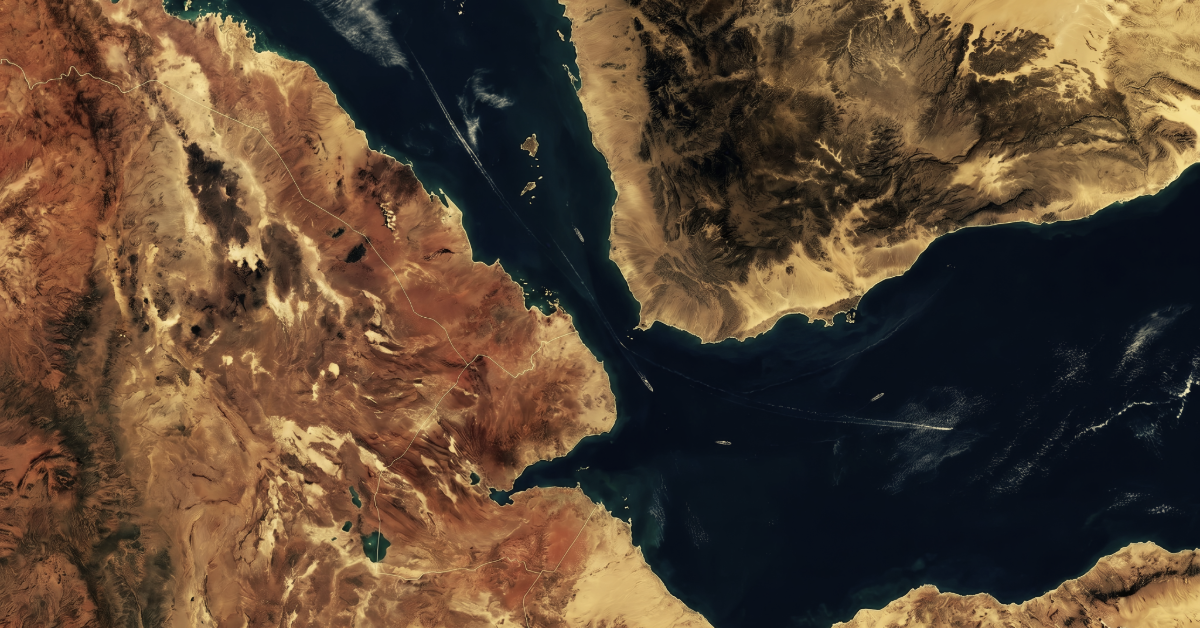
As Middle East tensions flare up again, the Strait of Hormuz dominates the headlines, and for good reason, given the volume of oil and fertilizer that flows through it. But roughly 1,500 miles to the southwest, a much narrower and arguably more fragile waterway has been absorbing just as much strategic pressure with a fraction of the coverage. The Bab al-Mandab Strait — just 18 miles wide at its tightest point — has become the quiet second front in this crisis, and it deserves a much bigger place in the conversation about food and energy price stability.
Why Bab al-Mandab Gets Overlooked
Hormuz is the obvious story: it’s wider, it’s the direct exit point for Persian Gulf production, and Iran controls one of its shores. Bab al-Mandab, by comparison, doesn’t have a single dominant state actor attached to it in the public imagination, which is part of why it’s underpriced in most risk conversations. But that framing misses two things. First, Bab al-Mandab is the corridor Gulf cargo has to clear after it survives Hormuz, on its way to the Red Sea, Suez Canal, and European and North American markets. Second, it’s overlooked precisely at the moment it’s become the workaround route for traffic fleeing Hormuz congestion — Saudi Arabia has been rerouting crude through its Red Sea terminals specifically to avoid Hormuz, which routes that cargo directly through Bab al-Mandab instead. The strait that nobody’s talking about is quietly absorbing the overflow from the strait everybody’s talking about.
A Waterway Genuinely Under Fire
Unlike Hormuz, where the threat has largely been the specter of closure, Bab al-Mandab has already seen sustained attacks. Yemen’s Houthi movement, widely described as aligned with, though not directly commanded by, Tehran, has targeted commercial vessels in the Red Sea corridor since late 2023, and Houthi officials have explicitly floated closing Bab al-Mandab in coordination with any Hormuz closure. Major carriers have responded accordingly: Maersk paused Trans-Suez sailings through Bab al-Mandab outright, citing security risk rather than waiting to see how the conflict developed.
The volume data tells the story of a route under real strain, not just rhetorical threat. Oil flows through Bab al-Mandab averaged 9.3 million barrels per day in 2023. Houthi attacks cut that roughly in half, to about 4.1 million bpd in 2024 and 4.2 million bpd in the first half of 2025. Flows have since partially recovered, back up to around 7.4 million bpd as of June 2026, but that recovery is itself a warning sign: it reflects Saudi Arabia funneling more crude through Red Sea terminals to dodge Hormuz, concentrating more risk onto a strait that’s already proven it can be attacked and disrupted for months at a time. Saudi oil loadings have reportedly dropped 36% recently as Houthi threats have intensified again.
This is a strait that carries about 12% of global trade and roughly a quarter of global container traffic, is 18 miles wide, sits next to an active militant force with a demonstrated willingness and capability to strike shipping, and has no equivalent of a US Navy deterrent posture the way Hormuz does. That combination — high volume, narrow geography, active hostile fire, thin protection — is a genuinely dangerous risk profile, and it’s not getting priced into public discussion the way Hormuz is.
The Food and Energy Stability Problem
Here’s where the two straits stop being separate stories and become one supply chain risk. Hormuz supplies the fertilizer and energy; Bab al-Mandab is one of the main paths that cargo has to travel to reach the rest of the world. When analysts model a simultaneous disruption at both chokepoints, the numbers get serious fast: an estimated 22% of global oil supply in transit jeopardy, and around 30% of global container shipping knocked off its normal routing. Qatar’s LNG exports to Europe, about 30 million tonnes a year, depend entirely on clearing Bab al-Mandab southbound before heading north through the Red Sea and Suez, meaning a Bab al-Mandab disruption can hit European energy security even if Hormuz reopens tomorrow.
On the food side, the picture is worse. Wheat, fertilizer, and edible oils all move through Bab al-Mandab in significant volume, and with the strait heavily restricted, cargo bound for Jeddah or Aqaba has had to reroute entirely around Africa, adding weeks of transit time and cost that only high-priority cargo can absorb — grain and oilseed shipments into the Middle East Gulf have thinned out as a result. Modeling on a sustained dual-closure scenario projects up to 45 million additional people pushed into acute food insecurity in 2026, with food insecurity rising an estimated 21% across West and Central Africa and 17% across East and Southern Africa. Urea prices are already up 86% year-to-date, and countries like India (the world’s largest urea importer) and Brazil (which sourced 40% of its entire 2025 urea supply through Hormuz) are exposed on the front end of that chain.
Why This Matters to Farmers
For a Midwest operation, none of this looks like it should matter directly — you’re not shipping soybeans through the Red Sea. But you are buying urea and phosphate that priced off a global market that assumes both of these straits stay open, and you’re buying diesel and inputs tied to natural gas prices that move with the same risk premium. When Bab al-Mandab absorbs more Hormuz overflow traffic while simultaneously sitting under active fire, the insurance and freight surcharges baked into that cargo’s cost don’t stay overseas — they show up in your next fertilizer invoice and your fuel bill.
The mistake is treating Hormuz as the single point of failure in this story. It isn’t. It’s one half of a two-strait system, and the half getting less attention is arguably the more exposed one right now. Input budgeting for the next planting cycle should account for both risks, not just the one making the news. It is never too soon to begin planning for your next crop, especially when the market runs.
Consider risk management strategies that protect both revenue and inputs, especially when the market gives you opportunities, like it has this past week.
This newsletter may reference or quote publicly available information believed to be reliable. Any third-party content is used under principles of fair use for purposes of commentary, education, analysis, and criticism. All trademarks, service marks, and copyrights remain the property of their respective owners. No infringement is intended. This publication is provided for informational and educational purposes only and is not intended as investment advice or a solicitation to buy or sell any commodity, security, futures contract, option, or other financial instrument. Opinions expressed are those of the author as of the date of publication and are subject to change without notice. Past performance is not indicative of future results. Trading futures, options, and derivatives involves substantial risk and is not suitable for all investors. This newsletter is not for sale, redistribution, or republication, in whole or in part, without the express written consent of the author.