Last week, an oil contract hit over $100. It’s come down a touch since, but the bigger question is worth sitting with: what are the ramifications of that number for a farm operation?
The US is blessed with energy abundance — we’re the world’s #1 energy producer. But that’s good news for accessibility, not necessarily for price. And with corn and soybean markets whipsawing the past couple of weeks, predicting cash flow has become a genuinely tough job for anyone trying to pencil out the next few quarters.
Oil headlines feel abstract, until you translate them into a diesel and nitrogen bill. And right now, with two Middle East shipping chokepoints under simultaneous strain, that translation matters more than usual.
How Oil Prices Translate to Your Input Bill
A fantastic study by Kansas State Ag economist Greg Ibendahl found that every $10/barrel move in crude shifts diesel by roughly 42 cents per gallon and anhydrous ammonia by roughly $30 per ton. And that lag between an oil spike and a fertilizer price hike? It used to run about six months. Not anymore — it’s showing up in weeks. If you’re still budgeting on last year’s input-cost timeline, you’re already behind.
Running the Numbers on a Corn Budget
I ran the numbers on a simplistic corn budget (6 gallons diesel/acre, 150 lbs N/acre via anhydrous):
- $70/bbl → $77/acre
- $100/bbl → $93/acre
- $120/bbl → $104/acre
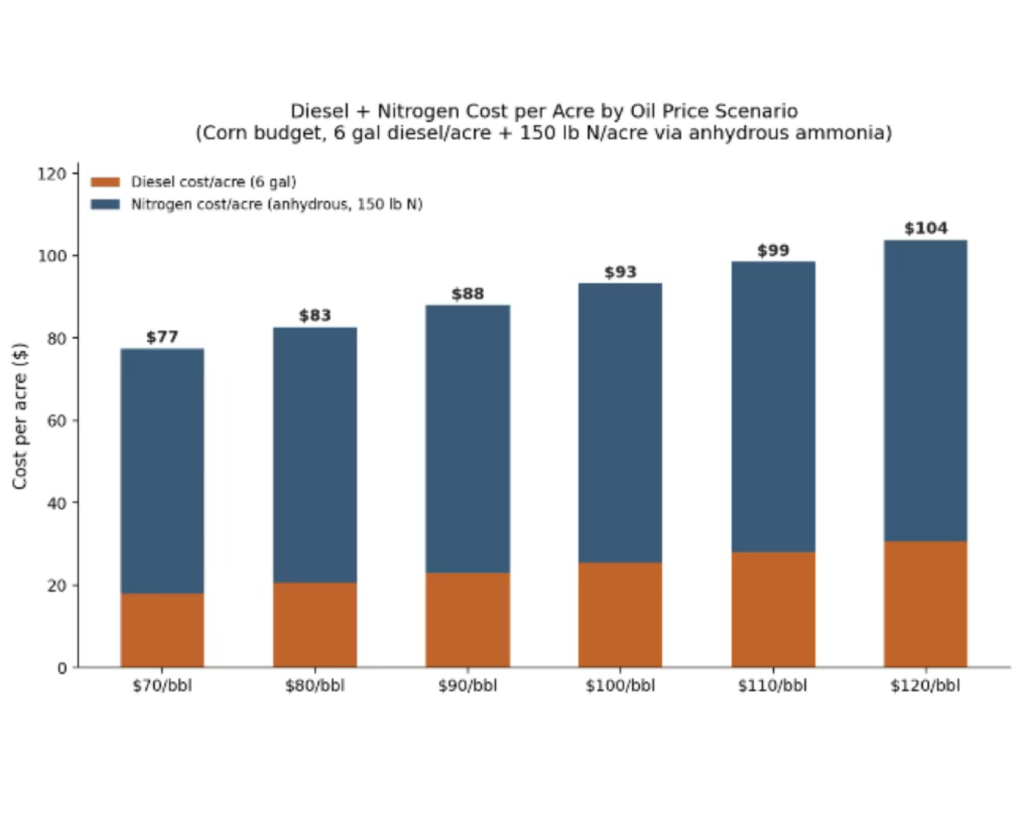
[Chart: Diesel + Nitrogen Cost per Acre by Oil Price Scenario]
On 1,000 acres, that’s a $16K swing with $100 oil up from $70 — and this only counts two inputs. Real-world DAP and urea moves this year have outpaced even this model, and diesel has stayed elevated even after crude pulled back. So, treat these numbers as a floor, not a worst case.
Why This Matters Beyond the Headlines
Here’s why this shouldn’t just sit in the back of your mind: a $100 oil regime doesn’t reset when the headlines move on. It resets your breakeven for the next several planting cycles. The farms and lenders who stress-test their budgets against $80, $100, and $120 oil before the next spike hits are the ones who aren’t scrambling when it does.
What to Do This Week
A few things worth doing this week, not next month:
- Run your own acreage and N-rate numbers through this same model — don’t assume the “average” farm figures above match your operation.
- Talk to your farm advisor now about how a sustained input-cost jump would move your breakeven, not after planting decisions are locked in.
- If you haven’t prebooked fertilizer for the next cycle, get pricing in front of you this week. The window to lock in ahead of the next move is usually shorter than it feels.
Curious what other operations are seeing right now — is prebooking still an option where you’re at, or has the window already closed? Drop a comment or send a message. Happy to walk through the model with anyone who wants to plug in their own numbers.
Sensitivity data: Ibendahl/Kansas State (via Farm Progress, Apr 2026). Scenario model is original analysis.
This newsletter may reference or quote publicly available information believed to be reliable. Any third-party content is used under principles of fair use for purposes of commentary, education, analysis, and criticism. All trademarks, service marks, and copyrights remain the property of their respective owners. No infringement is intended. This publication is provided for informational and educational purposes only and is not intended as investment advice or a solicitation to buy or sell any commodity, security, futures contract, option, or other financial instrument. Opinions expressed are those of the author as of the date of publication and are subject to change without notice. Past performance is not indicative of future results. Trading futures, options, and derivatives involves substantial risk and is not suitable for all investors. This newsletter is not for sale, redistribution, or republication, in whole or in part, without the express written consent of the author.